
If you think you can just pack your bags, move across the world, and figure out the details when you get there—you are setting yourself up for failure.
Every year, countless hopeful expats move to beautiful destinations like Florianópolis, Brazil, only to pack up and leave a few months later. Why? Because they couldn’t find a job, they misunderstood the tax laws, they underestimated their living expenses, or they simply weren’t financially stable. Moving abroad without prospects or preparation isn’t just risky; it’s poor planning.
The dream of living abroad is incredibly attractive. You imagine waking up somewhere with better weather, spending your evenings near the beach, exploring a new culture, and building a lifestyle that may not have been possible in your home country. But the reality is that the lifestyle comes after the planning—not before it.
If you want to move abroad and actually make it stick, you need a strategy. You need to know how you will earn money, where you will live, how much everything will cost, what your visa situation will look like, how taxes will affect you, and whether the destination actually works for your family.
Here is a breakdown of how to meticulously plan your escape and build a high-quality life overseas.
1. Secure Your Active Income Before You Move
The most critical part of planning your move is figuring out how you will support yourself financially. You cannot leave your income to fate.A beautiful country can quickly become a stressful place if you’re constantly worried about how you’re going to pay next month’s rent.
Before you move, you should ideally have a reliable income stream that can continue regardless of where you are physically located. Your goal isn’t simply to have enough money to survive the first few months. Your goal should be to create a sustainable financial system that allows you to actually enjoy your new life.
Remote-Proof Your Business
If you are a business owner, your company must be able to operate without your physical presence before you leave.You cannot systemize your business while fighting fires from thousands of miles away. Transition away from physical, location-dependent projects at least a few years prior to your move.Start documenting your processes, automating repetitive tasks, delegating responsibilities, and building a team that can make decisions without constantly waiting for you.The real test is simple: Could your business continue operating if you disappeared for 30, 60, or 90 days?
If the answer is no, you may not have built a location-independent business yet.
Find a Remote Job Early
If you are an employee, confirm that your current company allows international remote work.Don’t assume that because you can work from home, you can work from another country. Your employer may have restrictions related to taxes, employment laws, insurance, data security, or where employees are legally allowed to work.If they don’t allow international remote work, secure a fully remote job well before booking your flight.Ideally, you want to establish the job, understand your workload, test the remote arrangement, and build an emergency fund before you relocate.
Consider the Local Economy
If you are moving to a country with a lower average salary, attempting to live off local wages might not support the lifestyle you are used to.Earning in a stronger currency, like Pounds or Dollars, while living in a country with a lower cost of living is often the key to financial stability.This is one of the biggest advantages of becoming location-independent. Your income doesn’t necessarily have to decrease just because your cost of living does.
However, don’t assume that a lower cost of living automatically means a better financial situation. Taxes, private healthcare, international schools, imported products, travel, and lifestyle choices can significantly increase your actual monthly expenses.
Build an Emergency Fund
Before moving, calculate how many months you could survive without income.A few months of expenses sitting in an accessible emergency fund can make a huge difference when you’re dealing with unexpected costs, delayed payments, visa issues, moving expenses, or a sudden change in employment.The objective is to make sure one bad month doesn’t force you to abandon the entire plan.

2. Build the Ultimate Expat Spreadsheet
When planning a move, guesswork is your worst enemy.Years before making the leap, start building a comprehensive spreadsheet to compare your top destinations.Don’t just create a list of countries you like. Build a system that allows you to objectively compare them.You might initially fall in love with a destination because of its beaches, weather, or Instagram photos. But once you add taxes, rent, healthcare, education, security, visas, and flight times to the equation, your shortlist might look completely different.Here are the essential columns you need to research and rank for every potential city:
Security
How safe is the area? Don’t simply look at national crime statistics. Research the specific cities and neighborhoods where you would realistically live. Are there regional risks such as cartels, high crime rates, political instability, or frequent property crime that would make it unsuitable, especially for a family? Also consider everyday safety. Can you comfortably walk around your neighborhood? How safe is it at night? Are certain areas best avoided? How does the local security situation affect your daily routine?
Taxes
Do not bury your head in the sand. Look into worldwide income tax laws and understand how your foreign income will be treated. A country might seem cheap until you realize they heavily tax your foreign-earned income. You should also investigate whether you could become a tax resident, how many days you can spend in the country before triggering tax residency, whether your home country still has tax obligations for you, and whether tax treaties exist between the two countries. Taxes can completely change the financial calculation of an international move, so this is an area where professional advice can be worth paying for.
Cost of Living & Rent
Track realistic monthly costs. Look specifically at the cost of renting a comfortable home, such as a 4-bedroom house in a safe neighborhood, rather than relying on the cheapest apartment you can find online.
Break your monthly budget down into categories:
- Rent
- Utilities
- Groceries
- Transportation
- Internet
- Eating out
- Entertainment
- Domestic help
- Healthcare
- Insurance
- School fees
- Gym and hobbies
- Travel
- Unexpected expenses
The goal isn’t to calculate the absolute minimum cost of living. It’s to calculate the cost of living the way you actually want to live.
Visa Accessibility
How easy is it to get residency? Can your spouse or family members qualify easily? Can you work legally? How long does the process take? What documents are required? Do you need to renew the visa every year? For example, some families may be able to leverage Mercosur-related residency pathways in South America depending on their circumstances. Never base your entire relocation plan on a visa assumption you haven’t verified. Immigration rules can change, and the requirements can be very different depending on your nationality and family situation.
Time Zones
If you run a business or work remotely, time zones dictate your daily stress levels. A 3-hour time difference is manageable. A 10-hour difference means waking up at dawn to deal with client emergencies. Before moving, map your normal working hours against your clients, employees, suppliers, or headquarters. A destination might look perfect on paper, but if you’re regularly working from midnight until 6 a.m., the lifestyle may not be sustainable.
Education Costs
If you have children, research the exact costs of private primary and high schools. Don’t just look at tuition. Investigate registration fees, uniforms, transportation, meals, extracurricular activities, books, and other additional costs. Public schools in many popular expat destinations may suffer from frequent strikes or underfunding, while private international schools can be extremely expensive. Education can become one of the largest expenses for an expat family, so it needs to be part of your calculation from day one.
Domestic Help
One of the perks of moving to certain countries is the affordability of household help. Research the daily or weekly rates for cleaners and cooks. But don’t only consider the price. Understand local employment laws, working hours, contracts, holidays, and other obligations if you plan to employ someone regularly. This can also have a significant impact on your quality of life, especially if you’re moving with children and both adults are working.
Healthcare
What is the quality of the public hospitals? What does comprehensive private health insurance cost?
Research the quality of healthcare in the specific city you’re considering, not just the country as a whole. Look at the availability of English-speaking doctors, emergency services, private hospitals, dental care, specialists, and prescription medication. If you’re moving with children or older family members, healthcare accessibility should carry even more weight in your decision.
Flight Times
How long does it take to fly back to your home country to visit family or clients?
A direct flight is a luxury; a 24-hour, multi-layover journey is a massive logistical hurdle. Don’t underestimate this. Being able to reach your family in one reasonably straightforward journey can make a huge difference when dealing with emergencies, weddings, holidays, or simply wanting to visit home.
3. The Best Tools for Researching Your Move
You don’t need to guess the data for your spreadsheet. Leverage these tools to get accurate, up-to-date information:
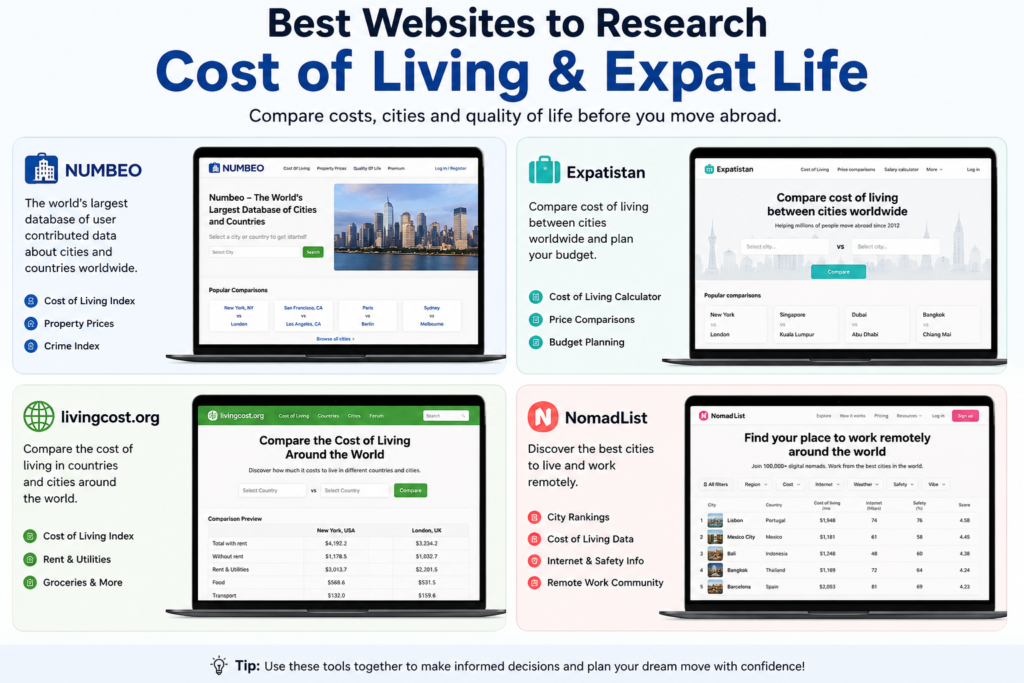
- Cost of Living Comparisons: Use sites like Numbeo, Expatistan, Livingcost.org, and NomadList to compare the exact price of groceries, rent, and utilities between your current city and your target destination.
- Weather and Climate: Weather is a massive factor for your daily happiness. Use WeatherSpark to put your current city and your dream city side-by-side to compare year-round temperatures, humidity, and cloud cover.
- Natural Disasters: Check regional risk maps to see if your chosen destination is prone to earthquakes, hurricanes, or flooding.
4. Align with Your Family
Finally, you cannot make this decision in a vacuum. Put all your research on the table and go through it with your spouse and children. A relocation that works perfectly for one person might be completely wrong for another member of the family. Ask the important questions: Do we want to live near the beach or the mountains? Do we want a place that is hot year-round, or do we prefer distinct seasons? Do we need to be a short flight away from aging parents? What kind of schools do we want? How important is access to healthcare? Do we want a large international community, or would we prefer to integrate more deeply into the local culture? How comfortable are we with learning a new language? How much travel back home are we realistically going to want? These questions are just as important as rent and taxes. Narrow down the map based on your family’s collective needs, language preferences, and cultural connections. Most importantly, make sure everyone understands what they’re gaining and what they’re giving up. Moving abroad isn’t simply choosing a better country. It’s choosing a different way of life.
Final Thoughts
A successful move abroad is the culmination of years of research, not a weekend whim. The goal isn’t to find a perfect country. There probably isn’t one. The goal is to find a destination where the important pieces of your life fit together: income, taxes, security, housing, healthcare, education, weather, family, culture, and quality of life. By prioritizing the heavy details—taxes, visas, secure income, realistic expenses, and family alignment—you can ensure your move is a permanent, life-changing success rather than a failed experiment. Don’t move abroad because you fell in love with a destination for two weeks. Move because you’ve built a life that can actually work there. The dream is the destination. The planning is what gets you there.