

If I could put my 40-year-old brain into my 20-year-old body, I’d be dangerous. I’m certain that if I knew then what I know now, I would have been a multimillionaire by 25. More importantly, I would have bypassed most of the pain and the nonsense I put myself through.
I might not have hundreds of millions in the bank today, but I am rich in ways that actually matter. I wake up every day without an alarm clock. I choose which of my businesses I want to work on. I choose my hobbies. I have the financial freedom and security to travel the world and take my family with me.
I started this channel hoping my sons might one day watch these videos and absorb some of this wisdom. But let’s be honest: kids rarely listen to their parents. I was arrogant when I was younger, and youth truly is wasted on the young.
If you are in your teens, twenties, or even your thirties, some of this might sting. But it is far better to hear it now than to spend years trying to figure it out and messing up along the way. I’ve survived a troubled youth, getting kicked out of school, trouble with the police, and drug addiction. I came out the other side.
Here are the hardest-earned lessons from my last few decades. Learn from the mistakes of others, because you haven’t got the time to make them all yourself.
1. The Massive Action Formula
There is one formula you need etched into the forefront of your brain. It should dictate almost every decision you make in life:
Massive Action × The Right Stuff × Consistency = Success
It isn’t just about working hard; it’s about working hard on the right things.
This formula also works in reverse. If you apply massive effort to the wrong stuff consistently, you will fail. At the extreme end, applying massive effort to bad choices and the wrong crowds can destroy you. You could work 16 hours a day on the wrong thing and just dig yourself deeper into a hole. People burn out, go bankrupt, and destroy their marriages all because they apply massive effort to meaningless endeavors—doom scrolling, binge-watching box sets, overworking blindly, or spending time with toxic people.
2. Find Your 20% (The Pareto Principle)

How do you figure out what the “right stuff” is? You use the 80/20 principle.
The basic premise is that 80% of your results come from 20% of your effort. In business, 20% of your customers might bring in 80% of your revenue, while another 20% of your customers bring in 80% of your complaints and team headaches.
You need to filter out the noise and find the 20% that actually drives your life forward. For most people, that 20% is going to be a combination of your health, your wealth (career or business), and your family.
3. Tiny Reps Compound (Mind Your Loops)
It is up to you how much you are willing to commit to those core areas, but you must try to be 1% better every day. If you can’t manage that, at least build 1% of something every day—whether it’s your business, your marriage, your body, or a creative skill. Compounding is a wonder of nature, but you have to make sure you are compounding the positive things.
Positivity begets positivity.
There are positive feedback loops and negative feedback loops. A positive loop looks like this: You eat well, so you sleep better, so you train better. You look in the mirror, feel good, and want to continue.
The problem is that it only takes a small disruption to break that loop. Going on a binge drinking weekend can completely throw out all the good work you did during the week, introducing a negative loop. One bad night’s sleep leads to junk food, which leads to skipping the gym, which leads to more stress and worse sleep.
Your job is to deliberately engineer as many positive feedback loops as you can, and relentlessly prune any negativity that could interrupt them.
4. The Law of Diminishing Returns
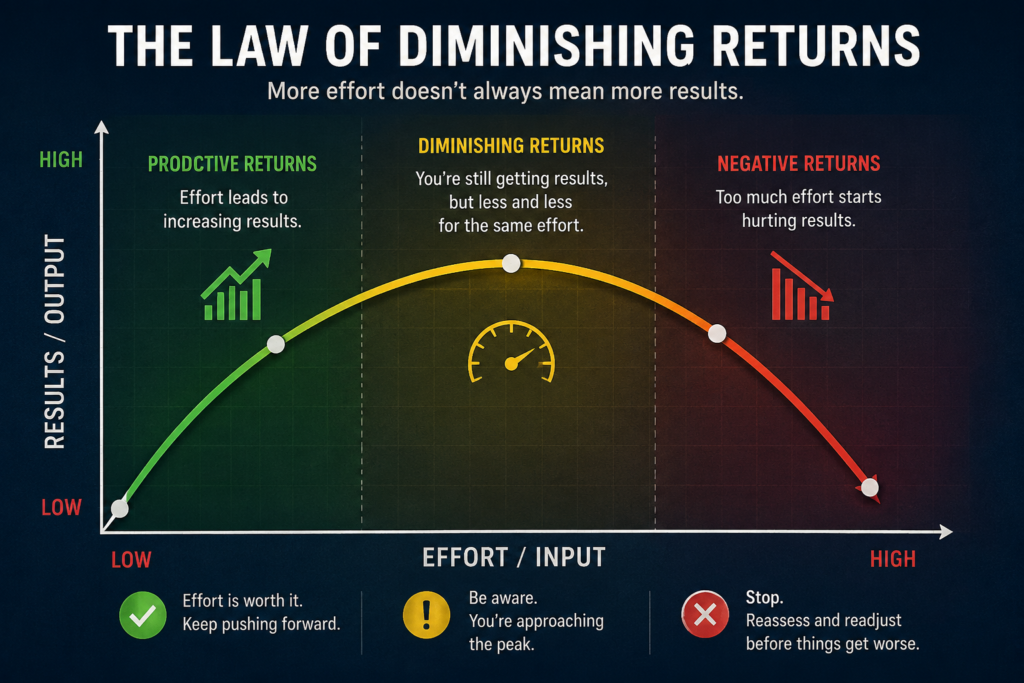
There is a point where more effort stops paying off, and a point after that where it actually makes things worse.
Use this interactive curve to see how pushing past the peak leads to negative returns:
Key insight: Everything on the left side of the curve is productive—every bit of effort gives you more back. But once you hit the peak, you enter diminishing returns. You are getting less and less back for your time.
If you keep pushing into the negative returns zone, you start burning out. Over-training ruins your body and plummets your testosterone. Overworking fries your brain and destroys relationships. Over-analysis leads to paralysis. The skill of life is learning to recognize where you are on that curve and stopping yourself before you head into negative territory.
5. Play the Long Game
If you are 20, you probably think you are late. At 30, you’ll wish you were 20 again. I’m 40 now, and outside of my family, I would give almost everything to have my 20-year-old body back with the knowledge I have now.
You can have everything you want in life, but you can’t have it at the beginning. You must possess the ability to delay gratification. Think in 20 or 30-year time horizons, just like Warren Buffett looks at the stock market. Over the short term, there will be wild fluctuations and dips—illness, loss, failure—but if you consistently put effort into the right stuff, the trajectory goes up.
The mountain might look daunting, but the sooner you start climbing, the quicker you reach the peak. As you get older, layers of responsibility are added on—kids, a mortgage, aging parents. The more layers you have, the less raw time and energy you have to devote to the climb. Gather your energy now and laser-focus it.
6. The Happiness Illusion
It took me until my mid-thirties to finally understand that happiness is a journey, not a destination.
I used to chase the next milestone: When I get the bigger house, I’ll be happy. When my business hits this revenue, I’ll be happy. When I have kids, I’ll be happy. When I get that car, I’ll be happy.
But every time you hit that milestone, it never feels the way you think it will. You never feel completely satisfied. As a species, we have a bottomless hole in us that demands we constantly achieve more and push boundaries. It’s what allowed us to conquer the planet, but that greed must be tempered.
There is always another mountain to climb. You might climb the wealth mountain once, but then you have to climb the health mountain, the fitness mountain, and the parenting mountain. Learn to love the climb itself, because the best views come from the hardest journeys.
7. Escape the Comparison Trap
I spent my twenties and early thirties looking at others flashing their wealth and traveling the world. I would just sit there scrolling, feeling like I was falling behind.
Every second you spend concerning yourself with what other people are doing is time and energy robbed from your own life. When you look at an influencer sitting on a private jet surrounded by money, it doesn’t make you feel good; it makes you feel inadequate and dissatisfied.
Stop feeding their algorithms. Stop giving them your time. Take that exact same energy and pour it into your own life to build something productive that enriches you and the people you care about. True freedom is when you do not care what other people think of you. Put the blinkers on like a horse, get your head down, and focus on your own work. You are only competing with yesterday’s version of yourself.
I will leave you with a quote from Marcus Aurelius that was written 2,000 years ago but has never been more relevant than it is today in our toxic, social-media-driven world:
“Do not waste what remains of your life in speculating about your neighbours, unless with a view to some mutual benefit… Anything that distracts you from your fidelity to the ruler within you means a loss of opportunity for some other task.